How to Write a Roofing Supplement That Gets Approved
By Editorial Team, Content Writer · October 19, 2026 · 14 min read

Table of Contents
- What a Roofing Supplement Is and Why Estimates Fall Short
- Step 1: Document the Damage Before You Write Anything
- Step 2: Compare the Adjuster's Scope With Your Own
- Step 3: Build the Roof Supplement Estimate Line by Line
- Step 4: Write the Roofing Supplement Letter
- Your Roofing Supplement Checklist Before Submission
- Denials, Partial Approvals, and How to Escalate
- Where Roofing Supplement Software Fits In
- Frequently Asked Questions
Last Updated: October 20, 2026
What a Roofing Supplement Is and Why Estimates Fall Short
A roofing supplement is a formal request to an insurance carrier asking for line items the first adjuster estimate left out or underpaid. We see the same pattern on claim after claim: the initial estimate covers the obvious damage and misses the rest.
That gap is not usually bad faith. Adjusters work fast, often from the ground, and they write to a standard scope rather than your specific roof.
Why the First Adjuster Estimate Is Rarely Complete
The first estimate is a starting point, not a final number. Adjusters typically inspect quickly and price common items from a template.
What gets missed most often:
- Ice and water barrier where code requires it
- Drip edge, ridge vent, and starter course
- Decking replacement for soft spots
Each missing line is money you absorb. The fix is documentation, not argument.
When a Supplement Is Appropriate
A supplement is appropriate when the scope of work is incomplete or the pricing does not match the actual job. It is not a tool for upgrading a roof the carrier already agreed to replace.
File one when you can point to a specific missing item and back it with evidence. That evidence is what separates an approval from a denial.
Step 1: Document the Damage Before You Write Anything
Documentation comes first, always. Walk the roof and capture evidence before you open a single line of the estimate. Contractors who write first and document later lose arguments they should win.
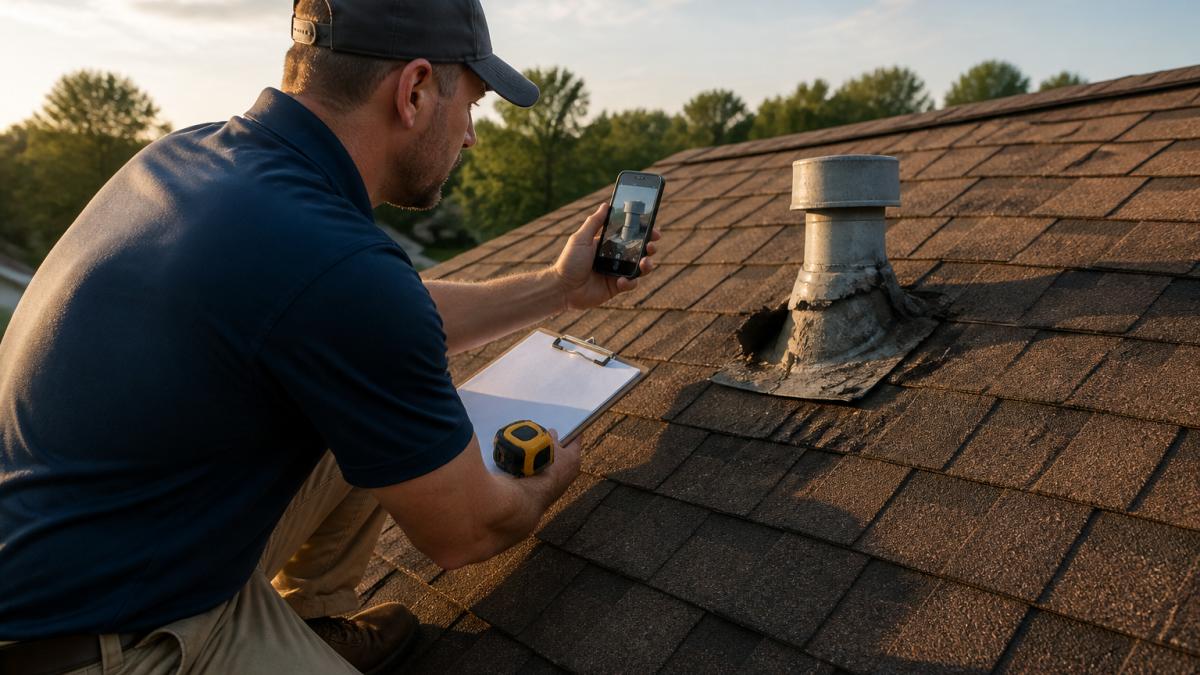
Photograph every slope, penetration, and transition. Measure the roof and record the pitch. Note the decking condition and any soft spots.
Keep a simple evidence log as you go:
- Wide shots of each elevation
- Close-ups of damage with a reference object for scale
- Measurements for every plane and penetration
Label files by address and date. A clean photo set makes the adjuster's review faster and your case stronger.
Step 2: Compare the Adjuster's Scope With Your Own
Put the adjuster's estimate and your scope side by side, line by line. This comparison is the heart of the supplement, and it is where most contractors rush.
Work through three questions for each line:
- Is the item present in the estimate?
- Is the quantity correct for the measured roof?
- Does the price match current material and labor costs?
Mark every gap. A missing ice and water barrier, a short decking quantity, or a labor line priced for a lower pitch all count.
Step 3: Build the Roof Supplement Estimate Line by Line
Build the supplement as a clean, itemized estimate that an adjuster can verify without calling you. Each line needs four things: a quantity, a unit, a unit price, and a stated basis for why the line belongs. The basis is what separates an approved supplement from a denied one.
Use this structure for every line item:
| Field | What to Write | Example Format |
|---|---|---|
| Line number | Sequential, matches your letter | S-01 |
| Description | Trade language, not marketing language | Ice and water barrier, 36 in., eaves and valleys |
| Quantity | Measured number only | 148 |
| Unit | LF, SF, SQ, EA, or HR | LF |
| Unit price | Current local rate | $[rate] per LF |
| Basis | Photo, measurement, or code citation | Photo 04; measurement sheet p. 2; IRC R905.1.2 |
| Justification | One sentence on why the original estimate missed it | Not included in carrier scope dated [date] |
Group Lines by Request Type
Adjusters review faster when requests are grouped by the reason for the change. Use four sections in this order:
- Omitted items, code-required or damaged work absent from the carrier estimate (ice and water barrier, drip edge, ridge vent, starter course, step flashing, counterflashing, pipe boots, permits).
- Quantity corrections, measured quantities that exceed the carrier's line (decking square footage, ridge and hip length, valley length, penetration count).
- Price corrections, labor or material rates below current local pricing (steep-slope and height charges, two-story charges, disposal, sales tax where applicable).
- General conditions, overhead and profit, permits, dumpster, temporary protection, and final cleaning where the policy and local rules allow.
Write Descriptions the Adjuster Can Price
Vague descriptions invite denials. Compare these:
- Weak: "Extra flashing." Strong: "Step flashing, 4 in. x 4 in. x 8 in. aluminum, at sidewall-to-slope transition, 42 LF, Photo 11 and measurement sheet p. 3."
- Weak: "More decking." Strong: "5/8 in. OSB decking replacement, 6 sheets, 192 SF, soft spots at north slope, Photos 07-09 with probe marks."
- Weak: "Code upgrade." Strong: "Ice and water barrier at eaves, 148 LF, required by adopted code section [cite local adoption], Photo 04 shows absence."
Show the Math
Every quantity correction needs a visible calculation. If the carrier estimated 22 squares and your measurement report shows 27.4 squares, write the difference and the source: "Measured 27.4 SQ per measurement report dated [date]; carrier scope shows 22.0 SQ; supplement requests 5.4 SQ." Do not round in your favor, adjusters check.
Attach Evidence Labels to Every Line
Number your evidence and reference it in the line item. A simple system works:
- P-01 through P-99 for photos
- M-01 through M-09 for measurement sheets
- C-01 through C-09 for code or manufacturer citations
When line S-03 cites "P-07, M-02, C-01," the adjuster can verify in seconds. That labeling habit is the single biggest time-saver in the supplement process.
Cite the Right Authority
The International Residential Code sets baseline requirements, but local amendments control. Cite the version your jurisdiction has adopted, and name the amendment if one exists. For manufacturer requirements, follow the shingle manufacturer installation instructions for the specific product rather than a generic guide. If the carrier disputes a code item, the adopted local code, not the model code, is the controlling document.
Step 4: Write the Roofing Supplement Letter
The roofing supplement letter is the cover document that tells the adjuster what changed and where to find the proof. Keep it short, factual, and scannable. The letter should never argue coverage, it should document scope and point to evidence.
Know the Boundary Before You Write
A supplement documents damage and scope. It does not decide coverage, interpret policy language, or negotiate on a policyholder's behalf unless you are authorized to do so. Coverage depends on the specific policy, endorsements, exclusions, and the rules of the jurisdiction where the property sits. If a line turns on a policy interpretation, state the factual basis and let the adjuster apply the policy, or refer the policyholder to a licensed public adjuster or attorney where state law requires it.
Use This Letter Structure
Subject: Supplement Request, [Property Address], Claim [Number], Carrier Estimate Dated [Date]
Dear [Adjuster Name],
Thank you for the estimate dated [Date]. After a full inspection on [Date], we identified items the original scope did not include or priced below the measured scope. Each item below is supported by the attached evidence.
Summary of request: [X] omitted items, [Y] quantity corrections, [Z] price corrections, and general conditions as itemized.
Run Quality Control Before You Send
Most delays come from avoidable errors, not disputed coverage. Check every submission against this list:
- No duplicate line items across sections
- Every quantity traces to the measurement report
- Unit prices match supplier quotes or current local rates
Track the Submission
Keep a simple submission log: date sent, method (portal, email, fax), recipient, items requested, and response date. If the carrier does not respond within the timeframe set by state claims-handling rules, follow up in writing and reference the date of the original submission. A dated paper trail is what makes an escalation credible later.
Your Roofing Supplement Checklist Before Submission
Run this roofing supplement checklist before you hit send. A few minutes of quality control prevents a denial and a resubmission.
- Every requested line has a photo or measurement
- Quantities match the measurement report
- Code citations name the correct jurisdiction
Denials, Partial Approvals, and How to Escalate
A denial is not the end of the claim. Many supplements come back partially approved, and some are rejected outright. Both are normal.
When you get a partial approval, review what was cut and why. If the carrier disputes a line, respond with the specific evidence for that item.
Escalation options, in order:
- Request a re-inspection with the adjuster
- Ask for a supervisor or claims manager review
- Submit a formal reconsideration with new evidence
Follow the state insurance department complaint process if a claim stalls unfairly. Keep every communication in writing and dated.
Where Roofing Supplement Software Fits In
Roofing supplement software removes the manual cross-checking that eats estimator time. Instead of comparing documents by hand, the tool flags gaps for you to review.
ScopeProof cross-references the adjuster estimate against your measurement report, manufacturer requirements, and local code.
What that means in practice:
- Missed line items surface before submission
- Code and manufacturer citations are attached automatically
- Material orders match job-specific measurements
It works for small shops as well as large ones, and you can try your first claim free to see the difference on a real job.
Frequently Asked Questions
What documents should you include with a roofing supplement?
Send the line-item estimate, measurement report, dated photos of each damaged component, and the manufacturer installation instructions or code citation that supports the item. Include a short cover letter that maps each requested line to its evidence. Insurers process supplements faster when every line item has a photo, a measurement, and a source, so the adjuster does not have to request additional information. Keep the packet in one PDF with matching line numbers.
Can a roofing contractor submit a supplement on a homeowner's behalf?
Yes, with written authorization. The policy belongs to the homeowner, so the contractor typically needs a signed direction to pay or an authorization form naming them as the representative on the claim. Once that is on file, the contractor can send the roofing supplement letter, answer adjuster questions, and request a re-inspection. Confirm the authorization covers supplement submission specifically, since some forms only cover repair work.
How do you respond if an insurance adjuster denies a roofing supplement?
Ask for the denial in writing and the specific reason for each line. Then respond point by point: attach the code citation, manufacturer requirement, or measurement that contradicts the denial. If the adjuster still refuses, request a re-inspection, escalate to the claims supervisor, and use the appraisal clause in the policy if the gap is large. Document every call and email, because a paper trail is what moves a stalled claim.
How long does it take to get a roofing supplement approved?
Many supplements are reviewed within one to three weeks, though re-inspections and code disputes add time. Approval speed depends mostly on submission quality: a clean roofing supplement checklist with photos, measurements, and citations attached to each line moves faster than a letter asking for a lump sum. Follow up once a week, and confirm receipt in writing so the review clock starts on a known date.
The hardest part of a roofing supplement is not the writing. It is catching every missing line before the carrier closes the file. If your team is losing scope to manual review, let ScopeProof do the cross-checking. It flags missed line items, cites the code and manufacturer rules behind each one, and drafts the letter and material order for your review. Get started with ScopeProof and submit supplements you can defend line by line.
- roofing supplement
- how to write roofing supplement
- roofing supplement letter
- roof supplement estimate
- roofing supplement checklist
- roofing supplement software