Is an Insurance Claim Estimate Review Service Worth It?
By Editorial Team, Content Writer · November 1, 2026 · 12 min read

Last Updated: November 2, 2026
Quick Summary
An insurance claim estimate review service checks the adjuster's repair estimate for missing items, wrong quantities, and prices that do not match your local market. It then prepares a supplement asking the insurer to pay for what was left out. Whether it is worth it depends on the size of your claim and how many items the review finds.
- Start by confirming every trade the damage requires is listed on the estimate.
- Check that quantities trace back to your measurement report, not a guess.
- Compare unit prices against local rates or a recent contractor bid.
- Ask each provider for a written quote covering pricing, deliverable, and turnaround.
Table of Contents
- What an Insurance Claim Estimate Review Service Does
- How Insurance Repair Estimates Are Prepared
- How to Read an Insurance Estimate Line by Line
- Comparing a Contractor Estimate vs Insurance Estimate
- How to Dispute an Insurance Estimate and File a Supplement
- Review Service Costs, Turnaround Times, and What to Expect
- Choosing Between an Estimate Review Service and Estimate Review Software
- Booking Your Next Estimate Review
- Frequently Asked Questions
What an Insurance Claim Estimate Review Service Does
An insurance claim estimate review service checks the repair estimate an insurance adjuster wrote for your roof. It looks for missing items, wrong quantities, and prices that do not match your local market. The goal is a more accurate payout for covered damage.
A reviewer reads the carrier's estimate line by line against your measurements and photos. They then write a supplement that asks the insurer to add what was left out. ScopeProof works the same way for roofing contractors, cross-referencing adjuster estimates against measurement reports and manufacturer requirements.
Most services handle roof, siding, and interior repairs. Some focus only on roofing. Ask which scopes they cover before you sign anything.
How Insurance Repair Estimates Are Prepared
Adjusters usually write the first estimate using estimating software such as Xactimate estimating platform. The adjuster inspects the property, measures the damage, and enters each repair task as a line item with a unit price.
The estimate reflects what the adjuster saw on one visit. It may not capture hidden damage, code upgrades, or the full set of trades that must work together. That gap is where most supplements come from.
Insurers also apply depreciation. Replacement cost policies may pay the full amount only after the work is done, while actual cash value policies subtract depreciation from the start. Check your policy language to see which applies.
How to Read an Insurance Estimate Line by Line
Reading an estimate line by line is a sequence, not a scan. Work through the checklist to use in this order so you do not miss a whole trade while chasing a small price difference. Work through it in this order so you do not miss a whole trade while chasing a small price difference.
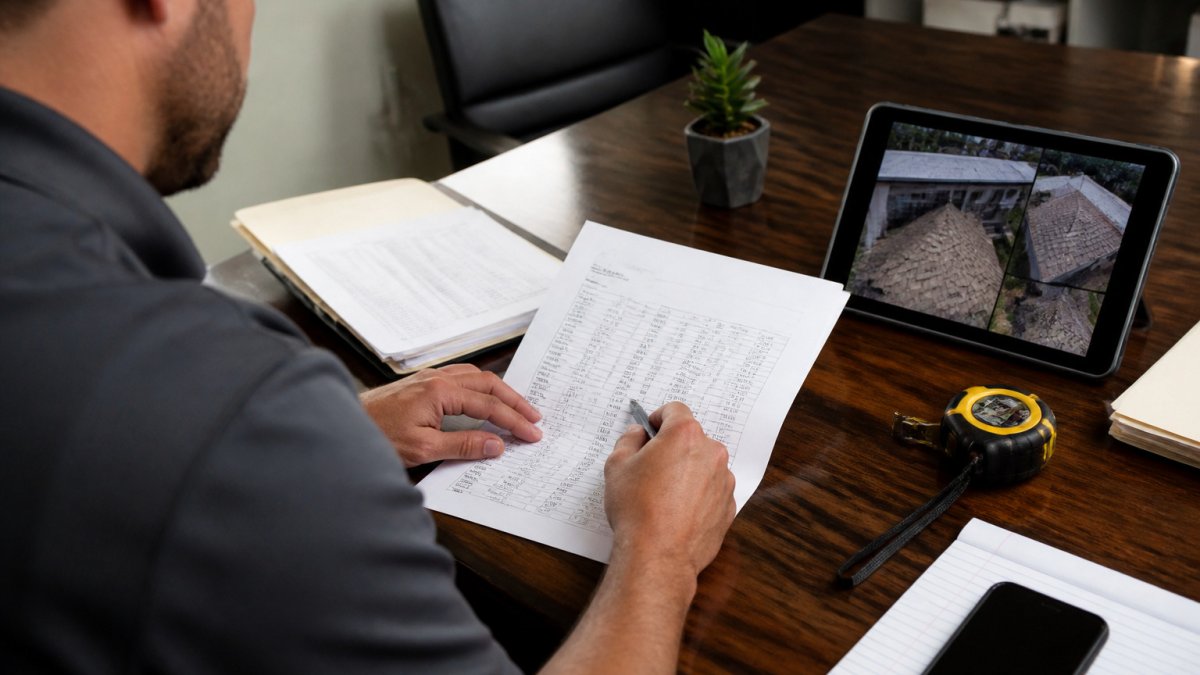
Step 1: Confirm the scope of trades. List every trade the estimate names, such as roofing, gutters, siding, drywall, paint, electrical, and debris removal. Then list the trades the damage actually requires.
Step 2: Reconcile the summary to the line items. Add the line items and compare the total to the summary page. Carriers occasionally carry a subtotal that does not match the lines beneath it, and a mismatch is the easiest correction to request because it is arithmetic, not opinion.
Step 3: Verify quantities against your own measurements. Pull your measurement report and compare it to the quantities on the estimate. Roof squares, ridge and hip linear feet, eave and rake linear feet, gutter length, and the count of vents, boots, and flashing pieces should all trace back to a measurement, not a guess.
Step 4: Check unit prices against local pricing. Unit prices vary by region, season, and material grade. Compare the estimate's per-square, per-linear-foot, and per-item prices against current local pricing data or a recent contractor bid in your area.
Step 5: Match the estimate to your photos. Walk your photo set trade by trade. Note any damage the photos show that the estimate does not list, and note any line the estimate includes that your photos cannot support. Both directions matter: an unsupported line can be removed later, which weakens your supplement.
Watch out: an estimate can look complete and still leave out an entire trade or a required permit. A missing trade often costs more than a wrong unit price, so finish the scope check before you argue about pricing.
Checking Quantities and Unit Prices
Quantities and unit prices drive the total, and they fail in different ways. A quantity error is usually a measurement or transcription problem. A unit price error is usually a pricing-data or material-grade problem. Treat them separately so your supplement asks for the right fix.
For quantities, confirm roof square footage against your measurement report, then check that squares, linear feet, and item counts match what you measured. For unit prices, compare each material and labor line against local rates and against the contractor bid you obtained. Record the line number, the estimate value, your supporting value, and the source of your supporting value.
- Compare roof squares to the measurement report, not to the contractor's verbal estimate.
- Confirm linear feet for gutters, drip edge, valley metal, and flashing.
- Check the unit price for each material against local rates and the contractor bid.
- Flag any quantity that does not match the photos or the measurement report.
- Note the line number and source for every discrepancy so the adjuster can verify it.
Spotting Missing and Incomplete Line Items
Missing items are the most common reason estimates come up short. Use this list of roofing line items adjusters often miss to check which ones your estimate leaves out. On a roof, look for starter strip, ridge cap, drip edge, underlayment, ice and water shield, valley metal, pipe boots, and step flashing. Many estimates also skip permits, haul-off, and overhead and profit.
Incomplete items are harder to spot because the line exists but does not cover the full task. A line that says "repair shingles" may not include the full replacement, the labor, or the disposal. Ask what each line covers, and compare the line description to the manufacturer's installation requirements for the product being installed. A line that omits a required component is a supplement candidate even though it is not technically missing.
The steps below summarise the line-by-line review sequence, with what to check at each stage.
| Step | What to check | Why it matters |
|---|---|---|
| 1. Confirm scope of trades | Every trade the damage requires is listed | A missing trade is a scope problem, not a pricing problem |
| 2. Reconcile summary to lines | Line items add up to the summary total | Arithmetic mismatches are the easiest correction to request |
| 3. Verify quantities | Quantities trace back to your measurement report | A documented discrepancy is easy to point to |
| 4. Check unit prices | Prices compared to local pricing or a recent bid | Low prices are worth questioning with a local comparison |
| 5. Match estimate to photos | Photos support every line and show missing damage | Unsupported lines can be removed later, weakening your supplement |
Comparing a Contractor Estimate vs Insurance Estimate
A contractor estimate is the bid you get from the company that will do the work. An insurance estimate is the carrier's version of the same job. The two often differ.
Lay them side by side. Match each contractor line to an insurance line. Where the contractor lists an item the insurer does not, that is a supplement candidate.
Some differences are legitimate. The contractor may use a different material or brand. Decide which differences are worth pursuing based on your policy and the manufacturer's installation requirements.
How to Dispute an Insurance Estimate and File a Supplement
A supplement is a request to add items or costs that the original estimate missed. Use a complete documentation checklist to gather the photos, measurements, and estimates before you send it. Build it around documented proof: photos, measurements, manufacturer requirements, and the contractor's itemized bid.
Send the supplement to the adjuster in writing. Keep the tone factual. Point to each missing item and attach the supporting document.
If the adjuster denies part of the request, respond to each point. See how to respond to a denied or partially approved supplement for a point-by-point approach. Ask for a reinspection if the denial rests on a fact you can disprove. Keep copies of everything.
Review Service Costs, Turnaround Times, and What to Expect
Review services are often priced in different structures, and the structure matters as much as the number. Ask for a written quote that states the pricing structure, what triggers an additional charge, and whether the fee is owed if no supplement is filed.
Turnaround time depends on the deliverable. A scope-and-pricing review of a single-trade roof claim is usually faster than a multi-trade review that requires measurement reconciliation and a supplement draft. Ask each provider three questions before you sign: what you receive at the end (a written report, a marked-up estimate, a supplement draft, or all three), how long the review takes from the date you deliver a complete file, and what happens if the adjuster requests a reinspection.
A complete file speeds the review more than any other factor. Gather the policy, the carrier's estimate, your measurement report, your photos, and any contractor bids before the review begins. A reviewer who has to request documents mid-review adds days to the timeline.
No review service can guarantee a specific payout. Insurers make the final decision on every supplement, and the reviewer's job is to document discrepancies and request corrections, not to set the settlement.
When you compare quotes, put them side by side on the same four lines: pricing structure, deliverable, turnaround, and what the provider does if the adjuster denies part of the request. The provider that answers all four in writing is easier to hold to the scope you agreed to.
Choosing Between an Estimate Review Service and Estimate Review Software
A review service gives you a person who reads the estimate for you. Software gives you tools to read it yourself. Your choice depends on how many claims you handle and how much time you have.
If you file one or two claims a year, a service may suit you better. If you run a roofing business and handle claims often, software can save time and build consistent documentation.
ScopeProof is claim-documentation software for roofing contractors. A free plan is available. Check ScopeProof's pricing page for current pricing and a quote.
Booking Your Next Estimate Review
Start by gathering your policy, the original estimate, your photos, and any contractor bids. A complete file makes the review faster and more accurate.
Then choose a review option that fits your situation. Ask each provider what they check, how they document findings, and what you receive at the end.
Get started with ScopeProof to check your next adjuster estimate. Try your first claim free.
Frequently Asked Questions
What does an insurance claim estimate review service do?
An insurance claim estimate review service compares the adjuster's estimate against your property's damage documentation, measurements, and local repair requirements. Reviewers look for missing line items, incomplete scopes, and unit prices that don't reflect current local labor and material costs. The output is typically a written list of findings and, in many cases, a supplement request you can submit to the carrier. A review does not guarantee the carrier will approve additional payment, since the final decision rests with the insurer and the policy terms.
How do I know if an insurance estimate is too low?
Start by comparing the adjuster's estimate to a contractor's estimate written from the same measurements and photos. Check whether every damaged component appears, including related trades such as gutters, flashing, or drip edge that are often omitted. Verify that quantities match your measurement report and that unit prices reflect your local market. If the carrier's total sits well below the contractor's on identical scope, the estimate likely needs a supplement or a formal dispute.
What should I check on an insurance repair estimate?
Review the scope of work first, then confirm each line item matches the damage you documented. Check quantities against your measurements, verify unit prices, and look for overhead and profit, permit fees, haul-off, and code-required upgrades. Confirm depreciation has been calculated and disclosed clearly, and note whether the estimate reflects your policy's replacement cost or actual cash value terms. Any gaps should be recorded with supporting photos and manufacturer or code citations before you contact the adjuster.
How do I challenge an insurance company's repair estimate?
Submit a written response to the adjuster identifying each disputed item, the reason it is missing or underpriced, and the supporting evidence. Attach measurement reports, damage photos, manufacturer installation requirements, and applicable building code references. Request a reinspection if the disagreement is about scope. If you still cannot reach agreement, review your policy's appraisal clause and any state-specific claim rules, since deadlines and procedures vary by state.

- estimate review service
- insurance claim estimate review service
- how to read an insurance estimate
- how to dispute an insurance estimate
- contractor estimate vs insurance estimate